Sweetish, CFHill - Stockholm 2026
Installation view, Sweetish , CFHill, Stockholm, 2026
Installation view, Sweetish , CFHill, Stockholm, 2026
Installation view, Sweetish , CFHill, Stockholm, 2026
Installation view, Sweetish , CFHill, Stockholm, 2026
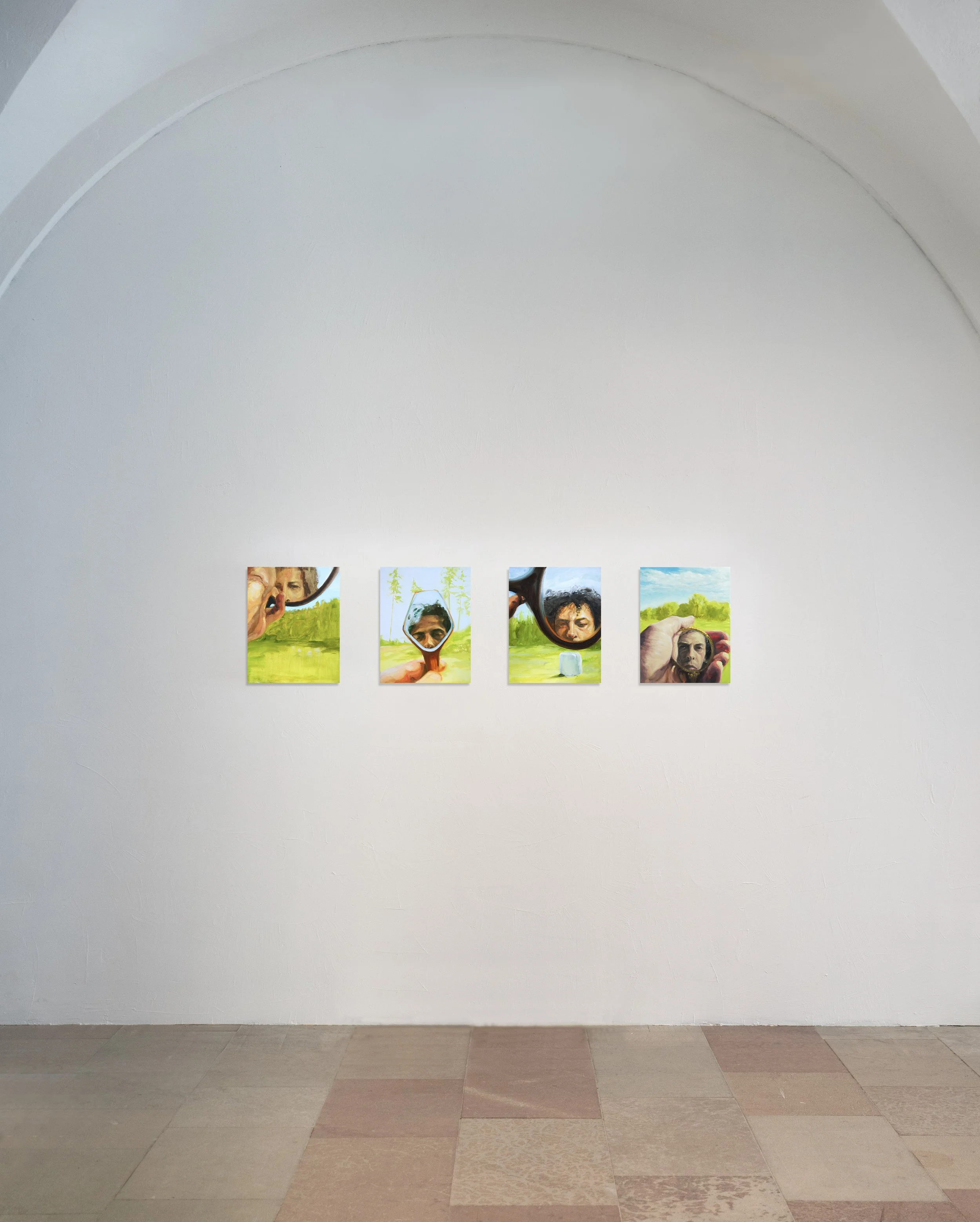
Installation view, Sweetish , CFHill, Stockholm, 2026
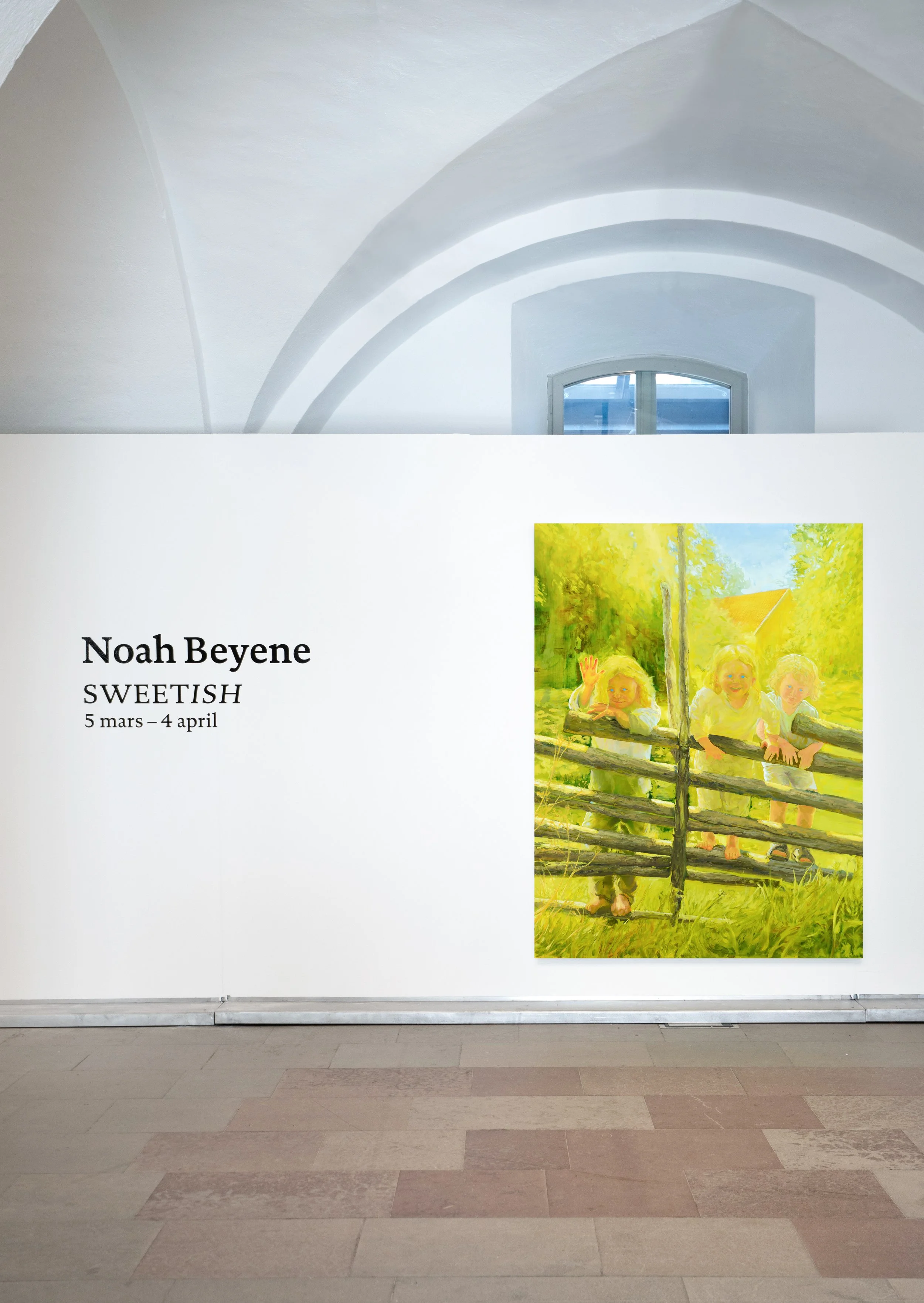
Installation view, Sweetish , CFHill, Stockholm, 2026
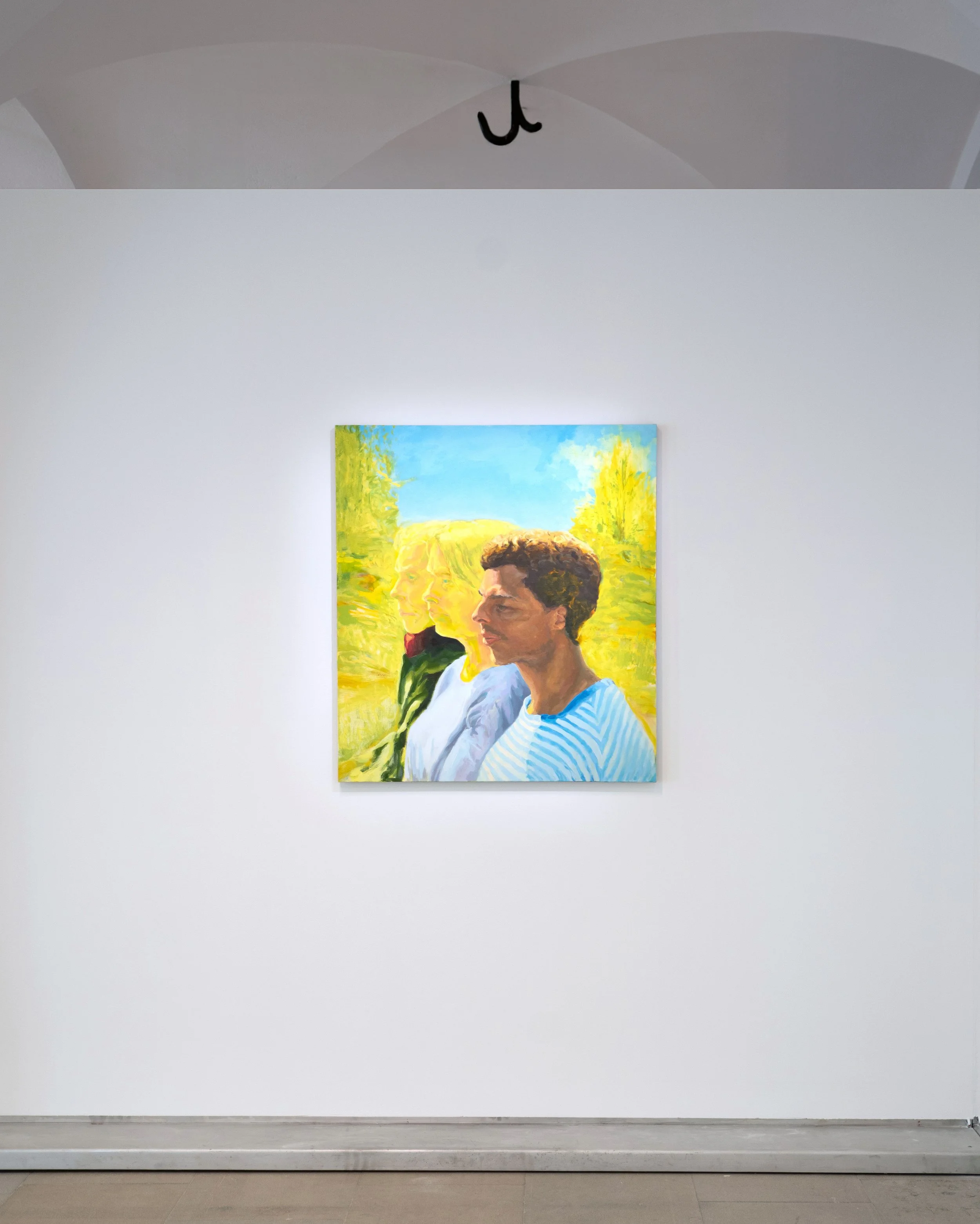
Installation view, Sweetish , CFHill, Stockholm, 2026
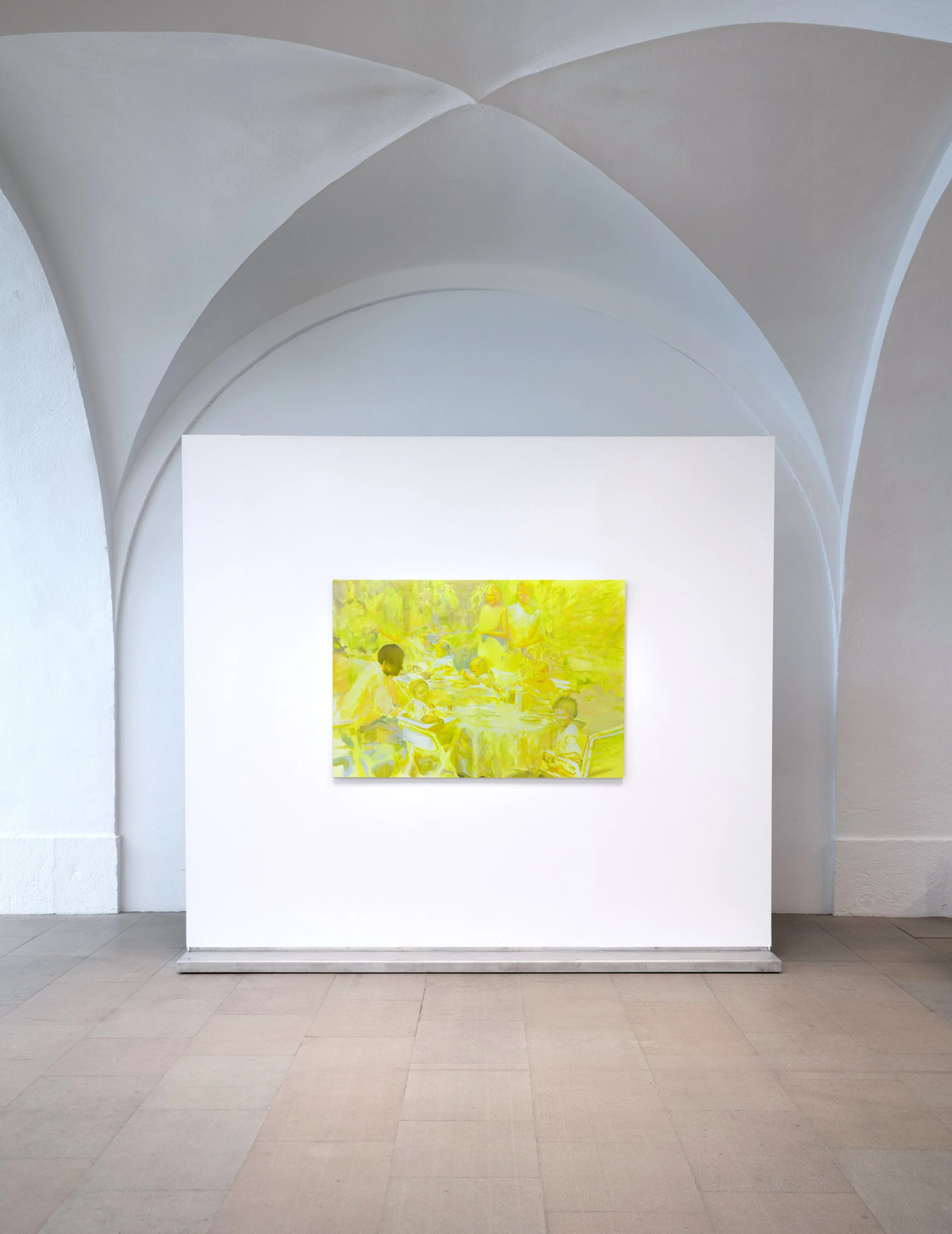
Installation view, Sweetish , CFHill, Stockholm, 2026
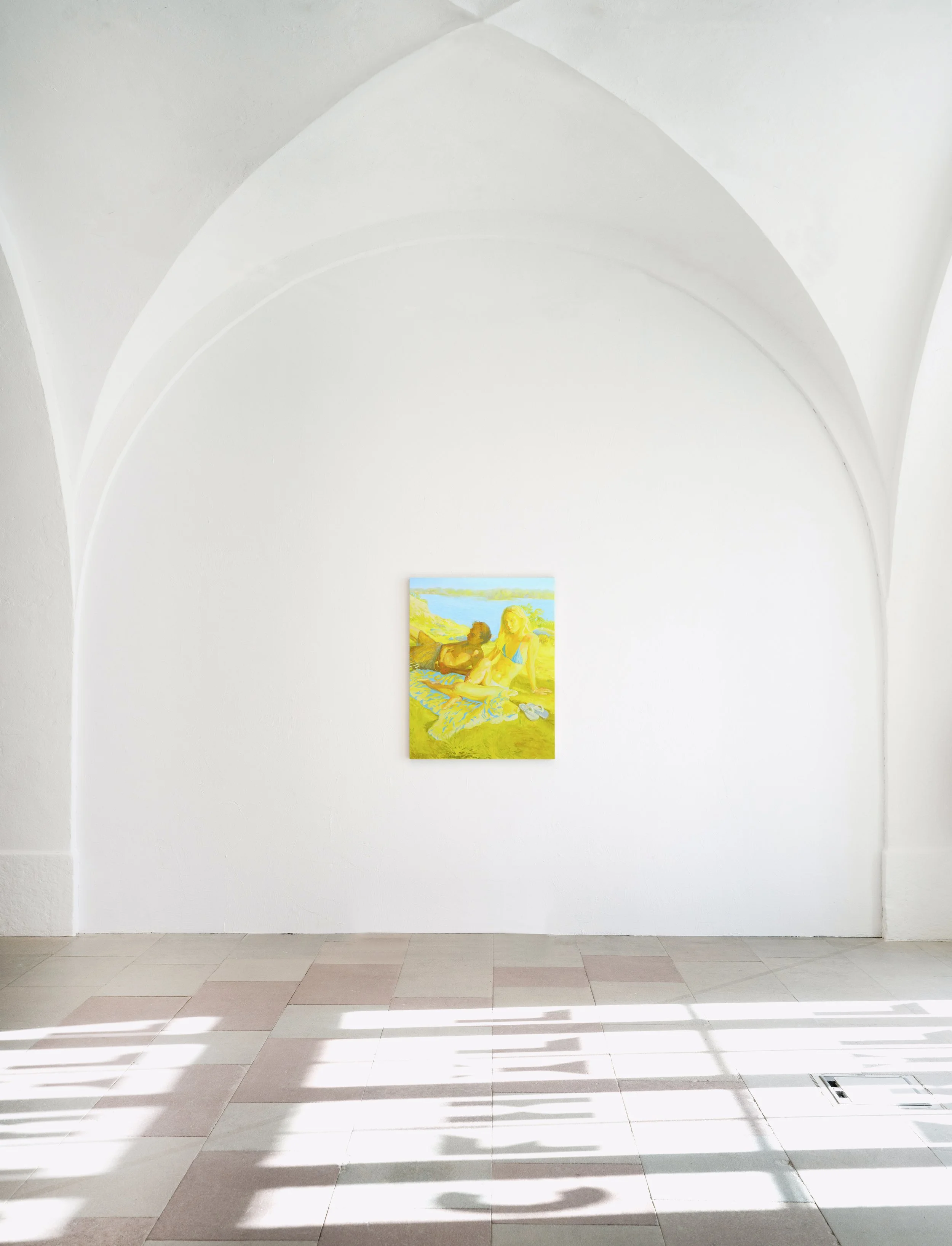
Installation view, Sweetish , CFHill, Stockholm, 2026
The Tiger’s Silence: Noah Beyene’s National Romanticism
Matthew Holman
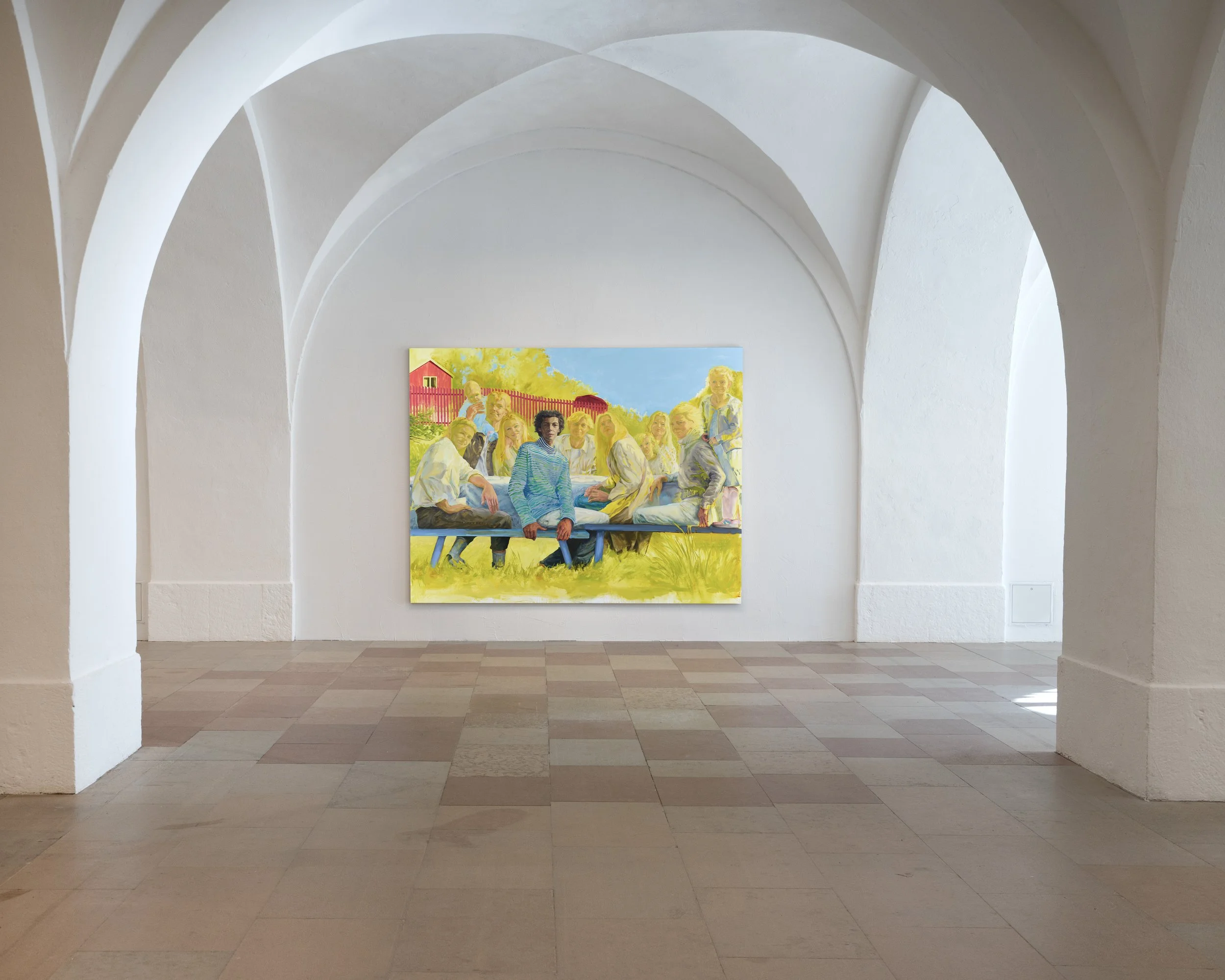
It is a dazzling late afternoon on the third Thursday of August. The air itself seems to radiate light. A flattened turquoise sky presses down while thickened sunlight pours over foliage in an almost implausible yellow. In the distance an outhouse and fence – both smouldering Falu red – arc toward the horizon. In the foreground, eight friends and four young children sit at a table, gazing loosely toward the place we would occupy were we encountering the scene in situ rather than its representation. All but one are blonde, dressed in crisp white shirts, as though a generation of urban bohemians had temporarily relocated to the countryside. They appear unmistakably Swedish.
The lone exception sits at the centre. His darker skin and striped sweater interrupt the chromatic agreement that binds the others together. The group leans inward in soft diagonals of familiarity; he alone faces outward, shoulders squared, meeting our gaze directly. In doing so he occupies a peculiar position: both the compositional anchor of the painting and its social margin. The gathering becomes less a group portrait than a picture of a culture rehearsing itself.
Across Sweetish (2024–25), London-based artist Noah Beyene returns to summer feasts, lakeside picnics, folk dress, and shared tables – not to document them, but to see whom they comfortably hold. In Preservation of Fishy Traditions (Surströmmingsskiva) (2024), northern light compresses the world into a single radiant key: grass, shirts, and faces drift toward the same yellow register, as if the landscape were quietly instructing the figures how to appear. Beyene does not stage exclusion as conflict but as optics. He thins his oil paint until it approaches watercolour, introducing a deliberate fragility into the surface. Errors cannot be corrected through layering; the painting must begin again. The resulting transparency lends the images a precarious lightness that mirrors their subject: traditions that appear stable but are, on closer inspection, contingent. The brightness that gathers the group also isolates the one figure who cannot dissolve into it.
In this respect Beyene – whose mother was born in Stockholm, and his father raised in Ethiopia – works inside the pictorial inheritance of Swedish National Romanticism. In the late nineteenth and early twentieth centuries, during a period of industrialisation, constitutional struggle, and the linguistic standardisation of svenska, painters such as Carl Larsson, Richard Bergh, and Anders Zorn did not simply depict Sweden; they taught viewers how to recognize it. Through the humble Dalagård interiors, bathing figures, and idyllic snow-driven landscapes, everyday life was organised into an image of belonging. In their work, the nation appeared less as history or law than as atmosphere: pale wood, white linen, reflective water, and the long northern afternoon. Regional habits hardened into shared memory and came to feel inevitable. Beyene adopts this same visual language but alters its effect. His communal gatherings repeat familiar forms yet refuse perfect harmony, not least through the persistent yellow tinge that continually unsettles the palette. The rituals remain – promising rest and continuity – but a contemporary anxiety emerges within them. What earlier painters used to stabilise a national image, Beyene employs to
test its limits, revealing tradition as something that must be continually performed in the present.
“In many ways, the images Larsson and Zorn produced were shaped by ideas about art they had brought back from abroad, and by practices that were, at the time, closer to rites than to established traditions”, Beyene reflects. “It is often through their work that these traditions became solidified on a national level rather than remaining regional or local.” Beyene replicates the domestic world of Swedish National Romanticism only to strip it of sentimentality, producing scenes of rural idylls without reassurance. This quiet destabilization resonates within a broader political context. In recent years, the Swedish far-right – particularly the Sweden Democrats – has championed the creation of a state-endorsed kulturkanon, formalized in the Tidö Agreement of 2022, as a pushback against multiculturalism. Such initiatives instrumentalize heritage, implying an organic and homogeneous tradition set in opposition to diversity. Beyene’s work resists this closure not by positioning itself outside National Romanticism, but by inserting figures like himself – Swedes of mixed heritage, or the children of immigrants – into its very grammar. As he puts it, the work is less about critique than about “drawing attention to the new wave of contemporary nostalgia that we’re living through, and whether art still has the power to make us believe in new ideas about ourselves and our society – and, just as importantly, who gets to tell that story.”
***
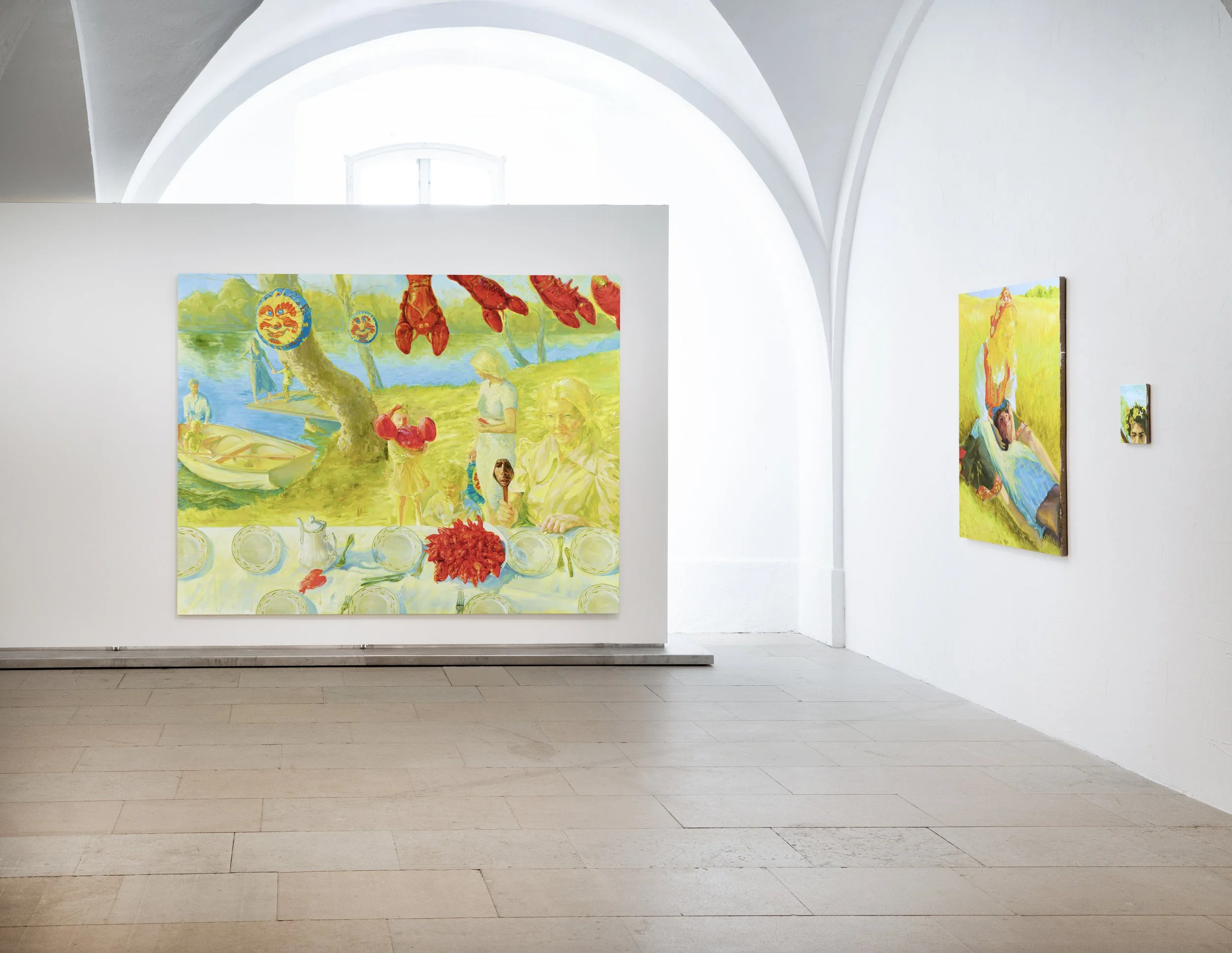
The title of Preservation of Fishy Traditions (kräftskiva) (2024–2025) plays on both the literal depiction of redder-than-red crayfish – to be deliciously paired with dill and aquavit – and on a colloquial expression implying doubt or suspicion. In the painting, children arrange paper lanterns with smiling moons and blow-up inflatable crayfish- shaped balloons around a long outdoor table while a handsome young father steadies a fishing boat to return his daughter to shore. In doing so, Beyene reimagines Carl Larsson’s depictions of the kräftskiva, or crayfish party, a ritual that emerged alongside Sweden’s expanding middle class in the nineteenth century. In 1907 the state introduced a closed season on crayfish fishing before early August to prevent overharvesting and protect dwindling native stocks, consolidating the celebration around a fixed date. What had been earlier associated with the aristocracy become the purview of the urban bourgeoisie before becoming spread across classes and media, transforming scarcity and regulation into a national symbol of abundance and sociability. As Beyene has observed, such traditions often hinge on contingent origins: a “pretty straightforward pictorial decision,” he notes of Larsson’s red crayfish motif, can “snowball into something that feels like cultural common sense,” slipping so fully into the national imagination that it seems always to have existed.
With Luncheon in Silence (En Svensk tiger) (2025), another work from the series, the artist inserts himself into a tranquil lakeside scene alongside a female companion. Her bikini mirrors the cold blue of the water, while – once more – a pervasive yellow tint saturates the composition. Together, this scheme recalls the bicolour Swedish flag, IKEA’s corporate palette, and En Svensk Tiger – the World War II propaganda campaign that encouraged silence as a defence against espionage. In the painting,
this emblem reappears as the rug beneath the seated figures. Gently evocative of Édouard Manet’s Le Déjeuner sur l’herbe (1863), in which the artist forced the bourgeois image to confront the social relations it preferred to naturalize, Beyene similarly works from inside an assumed pictorial language rather than rejecting it outright. If Manet’s contemporaries – who refused his Déjeuner entry to the Salon and instead consigned it to the Salon des Refusés – were scandalised by the confrontational realism of the woman’s gaze, read as brazen and indecent for its suggestion of contemporary sexuality rather than classical allegory, then Beyene’s image proposes a quieter disturbance, one that signals meaning without declaring it, maintaining the logic and double-meaning of tiga: to remain silent.
A seasonal shift brings us into winter. In Four Figures in the Snow (2026), we come face to face with an old man whose thinning grey hair and spindly hands suggest long familiarity with the landscape around him. He holds a mirror that captures the painter’s likeness within its oval frame, creating the fourth figure of the title (in fact, there are only two figures legible in the image) and folding self-portraiture into this Larssonian scene of austere leisure on the edge of the village. Specifically, the Falu red house in the middle-distance and the tenacious cross-country skier recalls Larsson’s The Skier (c. 1909), with its high wooden fence, red outbuilding, and carefully observed winter light. In Beyene’s painting, the artist’s reflected face never fully settles: it belongs to the scene yet appears in the landscape only through reflection, as if participation in the national image must occur indirectly.
Beyene has consciously modelled this device on Kerry James Marshall’s A Portrait of the Artist as a Shadow of His Former Self (1980), a small work on paper in egg tempera, which features a grinning, almost cartoon-like face emerging from a nearly black ground, and so introducing the central problem of Marshall’s practice: how to paint Blackness in a Western painting tradition historically structured around visibility, modelling, and light. Beyene’s wintry scene sharpens this tension. Where summer in Sweetish at least promises warmth and some sense of social ease, snow produces the kind of wincing contrast of exposure; nothing can blend into the whiter-than-white ground, and so every figure stands out.
This tension also comes into focus in Descending Order (2025), which places the artist’s late grandmother and mother alongside a self-portrait, each figure shown in profile against an impossibly blue sky. The painting evokes a dynastic group portrait – a format that usually promises clear lineage – only to unsettle the audience’s assumptions about race. Its title, borrowed from the absurdities of online shopping filters, points to an uneasy ranking of inheritance. Beyene describes the work as emerging from the ambiguity of being, as he puts it, “not really Black, not really white, and existing in this in-between space that can be hard to grasp or place,” and from a sense that, in Sweden’s current political climate, the value he is perceived to contribute is thus diminished.
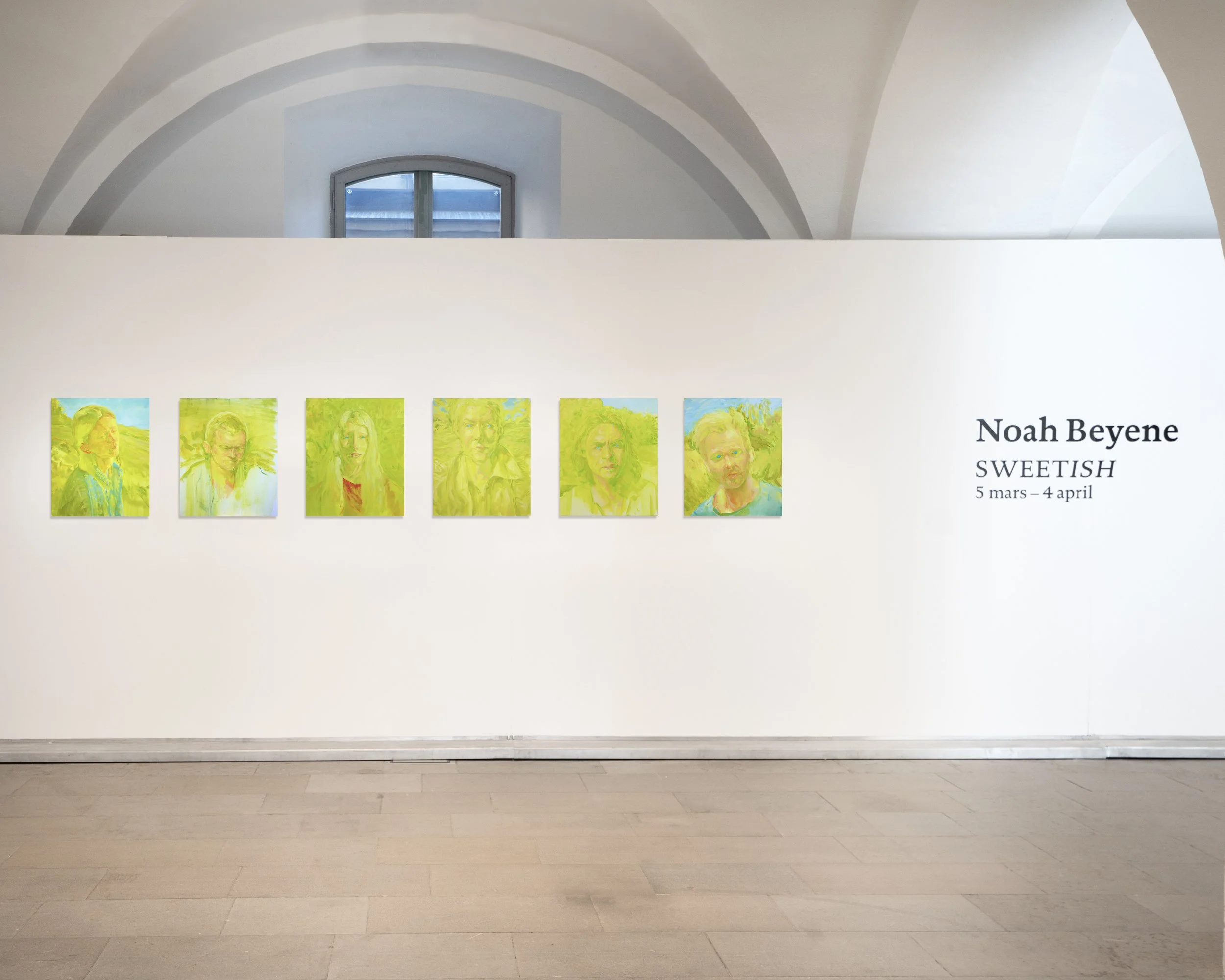
A quieter but equally incisive exploration unfolds in the Friendly Face series, six intimate portraits in a restricted palette of yellow, green, and blue, punctuated by occasional flashes of red, in which Beyene renders his subjects almost overexposed within the natural setting, as though the pastoral landscape itself has overwhelmed their singularity with an excess of colour. The figures nearly dissolve into their
surroundings. The paintings are therefore less concerned with who these individuals are than with how faces and bodies are read, how “fitting in” is recognised, and how quickly someone can be perceived as out of place. Beyene notes that he is frequently asked about his background in Sweden – a question that appears innocent yet marks difference at first glance. In these portraits, it becomes clear that the issue is no longer one of identity but ordinariness: not who the sitter is, but who is permitted to seem unremarkable, and to fade into their surroundings.
Beyene does not stand outside the tradition he examines. He works within it, exposing the strain required to keep its images coherent. In doing so, the paintings suggest that while memory plays its part in the construction and preservation of memory, it is more often produced through repetition – through the continual restaging of familiar scenes until they appear natural. Thus, what Sweetish reveals is not the failure of National Romanticism as an aesthetic with its own codes of meaning but their power: the ability of pictures to determine who seems to belong even before a word is spoken. The silence implied by the tiger lingers here. The question the works leave us with is therefore how an entire culture learns to see – and whom it learns not to see – in the first place.